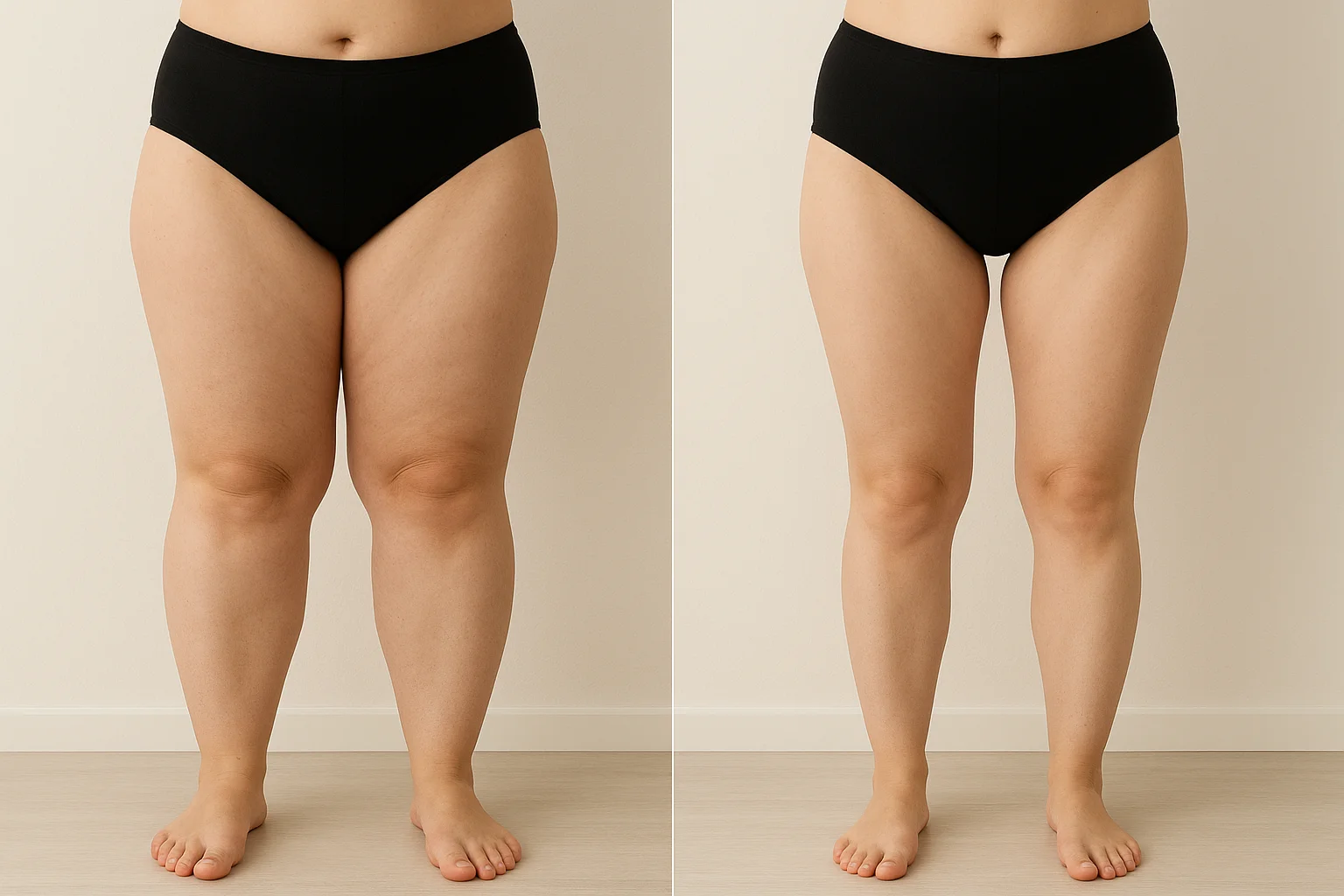
A question that comes up more often now
I increasingly see patients who have lost substantial weight with the help of GLP-1 medication and are surprised that the mirror does not look exactly like the scale.
They may have lost a significant amount of fat but still have fullness around the waist, loose abdominal skin, or a contour that feels disproportionate.
This is where the distinction between fat and skin becomes critical.
What Lipo 360 actually means
“Lipo 360” is a descriptive term rather than a single standardized operation. It generally refers to circumferential liposuction of the trunk, which may include the abdomen, flanks, waist and back.
The purpose is contouring.
Liposuction is not a substitute for weight loss, and it is not a skin-removal procedure.
Why that matters after GLP-1 weight loss
After major weight loss, a patient can have relatively little residual fat but a considerable amount of excess skin.
The American Society of Plastic Surgeons explains that after significant weight reduction, skin and tissues may lack sufficient elasticity to conform to the body’s smaller size. Body-contouring procedures may therefore be required to remove excess skin and improve contour. ASPS — Body Contouring
This is one of the first things I evaluate when someone comes in asking for Lipo 360.
I want to know whether the contour problem is actually fat, or whether the patient is looking at a loose skin envelope and calling it fat.
Lipo 360 versus a tummy tuck
The procedures solve different problems.
Liposuction removes selected deposits of subcutaneous fat.
Abdominoplasty, or tummy tuck, removes excess abdominal skin and can address abdominal-wall laxity when appropriate.
A patient can need one, the other, or both.
For example, a patient may have good abdominal skin but persistent fullness around the waist. Liposuction may be reasonable.
Another patient may have a lower-abdominal overhang after major weight loss. Removing more fat will not remove that skin.
What about the “snatched waist”?
Social media has popularized the idea that every body can be sculpted into the same hourglass.
Human anatomy does not work that way.
Ribcage width, pelvic shape, skin elasticity, abdominal-wall anatomy and the distribution of remaining fat all influence the result.
My objective would not be to create the smallest waist technically possible. It would be to create a contour that makes sense for the patient’s proportions.
A better consultation question
Instead of asking, “How much fat can you remove?” ask:
“What is preventing my abdomen and waist from having the contour I want?”
That question leads to a much better surgical discussion.
The bottom line
Lipo 360 can be an excellent contouring procedure for the right patient after weight loss. But it cannot remove a significant excess-skin envelope.
After GLP-1 weight loss, the correct operation is determined by the anatomy that remains—not by the medication that produced the weight loss.
GLP-1 medication disclosure matters before surgery
Patients taking semaglutide or another GLP-1 medication should tell the surgeon and anesthesia team before an operation.
FDA labeling notes delayed gastric emptying and rare postmarketing reports of pulmonary aspiration during general anesthesia or deep sedation. FDA: Wegovy Prescribing Information
The correct response is individualized perioperative planning—not a generic internet instruction to stop medication.
Educational information only. Individual treatment decisions require a qualified physician.